
By Connor Gardiner September 28, 2026
A merchant account when buying a business generally should not be treated as an asset that automatically follows the sale. Payment acceptance is tied to a merchant entity, its processing profile, bank account, ownership and contractual relationship. Asset purchases commonly require fresh underwriting; stock purchases may preserve entity continuity, but processor review or account changes can still be required.
That distinction matters because buying a restaurant, retailer, medical practice, service company, or e-commerce operation does not automatically give the buyer the seller’s authority to submit card transactions.
A buyer can acquire the storefront, trade name, equipment, inventory, telephone number, website and even parts of the POS system while still needing a separate payment-processing arrangement.
The opposite mistake is also possible. Saying that merchant accounts “never transfer” is too absolute. In a stock or equity acquisition, the corporation or LLC that signed the merchant agreement may remain intact. The actual result then depends on the merchant agreement, processor or acquiring-bank policy, the ownership change and any required review.
Asset Purchase vs. Stock Purchase: The Payments Answer at a Glance
Deal structure is the first question to resolve when evaluating a merchant account when buying a business.
An asset acquisition usually creates a clearer separation: the buyer’s entity purchases selected assets from the seller’s entity and begins operating the business. A stock or equity deal may leave the original merchant entity in place while the owners behind it change.
Ownership of a terminal is not the same as authorization to process through a merchant account. Similarly, possession of a POS administrator password does not establish ownership of the gateway, token vault, MID or processor contract.
What Must Be Ready Before Closing Day
| Item | Asset Purchase | Stock/Equity Purchase | Buyer Action |
| Merchant account/MID | Usually should not be assumed to follow purchased assets | May continue if the same entity remains, subject to provider requirements | Confirm treatment with processor/acquirer before closing |
| Processor agreement | Usually remains with seller unless provider approves another arrangement | Same entity may remain party to agreement | Review assignment and change-of-control provisions |
| Settlement bank account | Buyer ordinarily needs its own verified funding account | Existing account may remain or be changed | Confirm authorized bank account and funding path |
| POS hardware | Can transfer if seller owns it and sale includes it | Often remains property of the same entity | Verify ownership and processor compatibility |
| POS software account | Separate contractual issue | May continue but ownership/admin changes may be needed | Contact POS vendor |
| Gateway account | Does not automatically follow physical assets | May remain connected but changes may be required | Verify merchant profile, credentials and contract |
| Stored payment tokens | Migration may be required | May remain usable depending on platform/account continuity | Confirm vault ownership and provider-supported migration |
| Equipment lease | Requires separate review | Entity may remain obligated under lease | Review assignment, payoff and return provisions |
| Gift-card obligations | Must be allocated in transaction documents | Liability may remain in operating entity | Reconcile balances and technical redemption |
| Seller reserve | Usually associated with seller’s processing exposure | Depends on continuity of merchant relationship | Review agreement and processor treatment |
Payment processing should be treated like banking, insurance, payroll or a key software system: it needs a closing plan.
Before the transaction closes, the buyer should know:
- which legal entity will process card transactions;
- whether that entity has been approved;
- which MID or merchant profile will be active;
- which bank account will receive settlements;
- which terminals and registers will operate;
- which gateway credentials and integrations will work;
- what happens to stored customer payment credentials;
- whether existing gift cards can still be redeemed;
- who handles refunds and disputes relating to pre-closing sales; and
- what the seller still needs to maintain temporarily for legitimate wind-down activity.
Waiting until the day of closing to apply for processing creates an avoidable operational dependency because underwriting, requested documentation, gateway provisioning, terminal work or integration testing may require additional steps. There is no universal approval period that can safely be promised across processors, merchant categories and risk profiles.
Why a Merchant Account Is Underwritten to a Merchant, Not a Storefront
The central issue with a merchant account when buying a business is merchant identity.
An acquiring relationship is established around a merchant and its expected activity. Depending on the provider and risk involved, underwriting information can include the legal entity, tax identification information, owners or principals, business type, goods or services, transaction channels, expected volume, average ticket, delivery model, refund practices, processing history, bank account and applicable licensing.
A MID—merchant identification number—is therefore not simply a serial number for a credit-card terminal. It identifies a merchant relationship within a processor/acquirer environment.
The payment stack also contains several distinct relationships:
| Component | What It Does | Why an Acquisition Matters |
| Merchant | Accepts payment from customers | Legal merchant may change |
| Acquirer/acquiring bank | Acquires card transactions | Must be comfortable with merchant risk |
| Processor | Processes authorization, clearing and settlement functions | Merchant profile or credentials can change |
| Payment gateway | Connects checkout systems with processing infrastructure | Account, API keys and tokens may require transition |
| POS provider | Operates checkout/business software | Hardware ownership does not equal software ownership |
| Card network | Sets network operating rules | Acquirers and merchants must operate within applicable rules |
Card acceptance depends on an acquiring relationship, not merely possession of a terminal. Under the current Visa Core Rules and Visa Product and Service Rules, an acquirer must have a merchant agreement with each merchant whose Visa transactions it accepts.
That helps explain why a change in the operating merchant cannot be reduced to moving the POS equipment from seller to buyer.
Does a Merchant Account Transfer When You Buy a Business?
Usually, a buyer should not assume that it does.
For an asset purchase, the buyer is commonly a different legal merchant from the seller. If New Buyer LLC purchases the assets of Seller Restaurant Inc., New Buyer LLC is not automatically the party to Seller Restaurant Inc. ‘s processing contract merely because it now owns the restaurant equipment and uses the same name on the door.
Current processor contracts provide concrete examples of why the agreement itself must be checked. Worldpay’s July 2026 U.S.
Merchant Processing Agreement for the identified Citizens/Regions program defines the merchant as the legal entity or sole proprietorship on the application and expressly requires notice of intended changes including a change in business form or sale of stock or assets.
It also restricts transfers of rights under that agreement. Those provisions apply to that specific agreement; they should not be presented as universal terms for every processor.
The lesson is not that Worldpay’s contract governs everyone. The lesson is that merchant-account assignment and ownership-change requirements are contractual and provider-specific, so the actual agreement in the deal room matters.
Asset Purchase vs. Stock Purchase: Why Deal Structure Changes the Answer
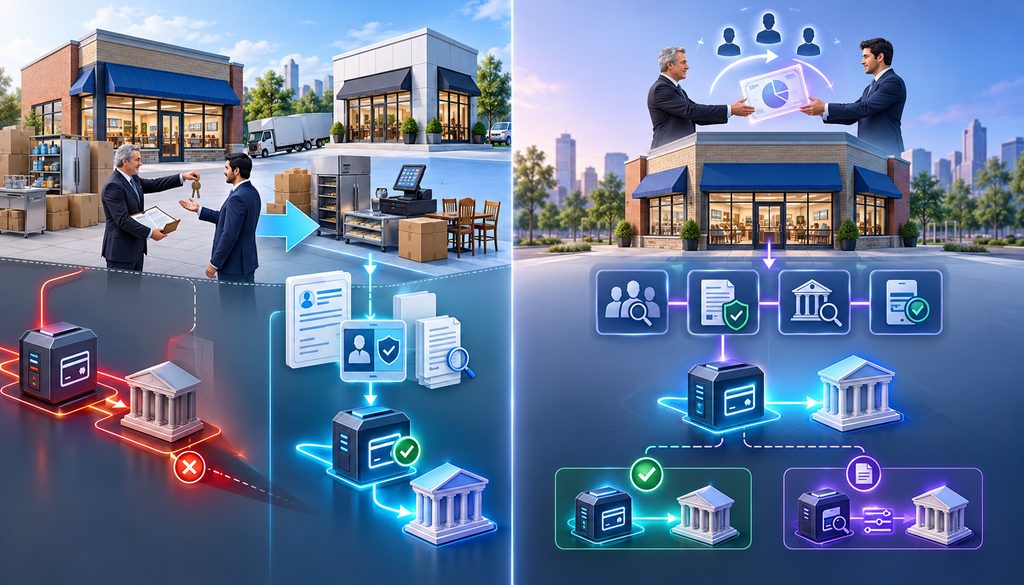
Asset purchase
In an asset acquisition, the seller typically continues to exist separately while the buyer acquires specified business assets.
If the buyer operates the acquired business through another entity, the practical expectation should be a new merchant account after asset purchase unless the processor/acquirer has specifically approved a different structure.
The buyer may preserve the DBA and customer-facing brand. That does not mean the legal merchant underneath the transaction is unchanged.
Stock or equity purchase
A stock purchase can produce a different result because the corporation whose shares are purchased remains the same corporation.
For example, if Acme Retail Inc. was the merchant before closing and the buyer acquires all of Acme Retail Inc.’s shares, Acme Retail Inc. may still be the legal party to the processing agreement after closing.
But that does not justify the shortcut:
“A stock purchase lets the buyer keep the merchant account automatically.”
Material ownership or control changes may be subject to notice, approval, updated merchant information or renewed underwriting under the applicable contract and provider procedures. A provider can also determine that changes to guarantees, banking information, merchant profiles, contracts or MIDs are necessary.
The safe operational rule for a stock purchase merchant account is therefore: notify the processor/acquirer before closing and obtain the provider’s actual transition instructions.
Payments Due Diligence Before Buying the Business

Payments due diligence when buying a business should establish what the target actually processes, what payment acceptance really costs, what contracts remain in force and what risk history the buyer is stepping into operationally.
Do not limit the request to one merchant statement.
Ask for enough information to identify normal activity, unusual months and seasonality where relevant.
Request these payment records
- recent merchant-processing statements;
- additional historical statements where seasonality makes them useful;
- processor funding/deposit reports;
- POS sales reports;
- current merchant-processing agreement;
- gateway agreement;
- POS software agreement;
- equipment purchase records;
- equipment leases;
- gift-card agreement and outstanding balance report;
- chargeback/dispute reports;
- refund reports;
- reserve and funding-hold information;
- account-warning or remediation notices;
- recurring-billing arrangements;
- marketplace and delivery integrations;
- e-commerce integrations;
- PCI-related charges;
- annual or monthly account fees;
- gateway charges;
- batch and statement charges;
- equipment fees; and
- tokenization, account-updater or recurring-payment service charges where applicable.
When reviewing processor statements, first identify whether the target is using flat-rate, tiered, or interchange-plus pricing because the pricing model determines how processor markup and underlying card costs appear. That makes it easier to separate payment-processing economics from gateway, software, equipment, and other operating expenses.
Separate processor cost from software cost
A processing statement or combined technology invoice can contain several categories that should not be blended together.
Separate:
- card interchange and network-related costs;
- processor/acquirer markup;
- gateway charges;
- POS or management-software subscriptions;
- equipment rental or lease payments;
- PCI-related charges;
- optional payment services; and
- unrelated SaaS or operational products.
This exercise matters because changing processors after an acquisition may remove one cost while leaving another contract untouched.
Verify the Seller’s Card Volume Instead of Trusting a Verbal Number
A statement such as “we run around $50,000 per month in cards” should be reconciled.
Compare:
- POS gross sales;
- processor-reported card volume;
- processor funding;
- cash sales;
- ACH receipts;
- refunds;
- chargebacks;
- sales tax where relevant;
- tips;
- third-party marketplace settlements;
- delivery-platform settlements; and
- financing or BNPL proceeds where relevant.
Illustrative reconciliation
Assume the seller reports the following for one month:
| Illustrative Item | Amount |
| POS gross sales | $65,000 |
| Cash/check sales | ($7,000) |
| Marketplace revenue settled elsewhere | ($5,000) |
| Direct card sales before refunds | $53,000 |
| Card refunds | ($3,000) |
| Net direct card activity | $50,000 |
These numbers are illustrative only, not industry averages.
The bank deposit can still differ from $50,000. Depending on the merchant arrangement, funding can be affected by settlement timing, refunds, chargebacks, reserves, fees or other adjustments.
That is why processing statements due diligence should compare multiple systems rather than trying to prove card volume from bank deposits alone.
A buyer should also compare merchant-service providers across pricing, contract terms, hardware, support, and security before deciding whether the seller’s existing provider relationship is worth preserving where continuity is possible or whether a different setup better fits the buyer’s operation.
Review Chargeback, Refund and Risk History
A seller’s processing history can matter even when the buyer expects to receive a new MID.
The reason is not that historical chargebacks automatically become the buyer’s card-network liability. They may instead reveal operating problems inside the business being purchased.
Look for:
- fraud concentrations;
- recurring-billing complaints;
- products frequently returned;
- delayed fulfillment;
- disputed cancellation practices;
- unusually large refund activity;
- chargeback clusters;
- processor warnings;
- account reviews;
- settlement holds; and
- reserve requirements.
Avoid assuming that a single generic “chargeback percentage” determines whether every merchant is safe. Network programs, provider risk controls and merchant contracts are separate layers, and the applicable rules can change.
MATCH and Terminated-Merchant Risk
During underwriting, an acquiring partner can use Mastercard MATCH Pro to check whether another acquiring partner previously terminated a merchant and the stated reason for that termination. MATCH is therefore an underwriting data point—not a business asset that automatically passes from seller to buyer.
Mastercard’s current product documentation says MATCH Pro allows an acquirer to identify merchants previously terminated by another acquiring partner and includes merchant and principal-owner information in the inquiry process.
That does not mean a buyer automatically inherits a seller’s MATCH status simply by buying the seller’s equipment, customer list or leasehold.
It does mean that a processor may ask questions when an application has meaningful continuity with an existing or former business. Those questions can involve merchant identity, principals, ownership, business activity and other underwriting information.
The buyer should describe the acquisition accurately and provide transaction documents when requested. Trying to make an acquired operation appear unrelated to its predecessor is not a sound underwriting strategy.
Detailed statements about MATCH reason codes, listing requirements or removal procedures should always be checked against Mastercard’s current documentation rather than relying on old processor articles.
Apply for the New MID Before Closing Day
Where fresh underwriting is required, the buyer should begin the business acquisition payment processing workstream early enough to resolve issues before the operating handover.
Providers may request some combination of:
- entity formation documents;
- EIN or tax documentation where applicable;
- ownership information;
- government-issued identification;
- bank documentation;
- expected card volume;
- average ticket;
- business description;
- card-present/card-not-present mix;
- business licenses;
- website information;
- location or lease documentation;
- historical processing statements; and
- acquisition documentation if needed to understand the transaction.
There is no defensible universal statement that approval takes a fixed number of days. Requirements vary by acquirer, processor, merchant category, volume, transaction channel and risk.
New MID after business purchase
A MID is a merchant identifier used within the acquiring relationship. A buyer receiving a new MID after business purchase should also confirm the systems attached to it.
Check:
- statement descriptor;
- terminal configuration;
- gateway merchant profile;
- website checkout;
- virtual terminal;
- online ordering;
- recurring billing;
- refund access;
- reporting accounts; and
- settlement bank account.
Keeping the same brand name does not necessarily mean keeping the same MID.
What Can Actually Transfer With the POS?

The statement “the POS comes with the business” needs to be unpacked.
POS hardware
Physical equipment may be a transferable asset if the seller actually owns it.
Possible assets include:
- countertop terminals;
- registers;
- tablets;
- kitchen displays;
- receipt printers;
- scanners;
- cash drawers; and
- network hardware.
The purchase agreement should identify what is owned versus rented or leased.
Processor compatibility
Even buyer-owned equipment may require reconfiguration or may not work with the buyer’s processor.
The buyer should verify device ownership, model, encryption/provisioning requirements and compatibility rather than assuming that possession equals portability.
POS software
Cloud POS software is another contract entirely.
Verify:
- who owns the account;
- whether the subscription is assignable;
- which entity is billed;
- administrator users;
- historical-data access;
- location configuration;
- inventory data;
- loyalty integration;
- gateway connection; and
- third-party integrations.
When evaluating an existing POS after buying a business, treat hardware, software, merchant processing and payment data as separate components.
Before keeping the seller’s payment stack, evaluate whether the existing platform can support the buyer’s required POS integrations, payment channels, security controls, reporting, and future transaction volume. An acquisition is often the point at which hidden dependencies between the POS, gateway, processor, and business software become visible.
Do Not Accidentally Assume an Equipment Lease
The equipment lease deserves its own diligence item because the terminal on the counter may not belong to the seller.
Before agreeing to assume a lease, review:
- legal lessee;
- remaining term;
- monthly obligation;
- termination terms;
- renewal provisions;
- assignment provisions;
- any personal guaranty;
- return requirements;
- end-of-term ownership; and
- any purchase option.
There is no universal lease structure. Some arrangements may be commercially reasonable; others may be poorly suited to the buyer.
The acquisition question is simply: what liability comes with the equipment, if any?
Gateway Ownership and Access Can Become a Closing-Day Problem
The gateway is frequently overlooked because it works quietly behind the POS or website.
For a payment gateway transfer after acquisition, determine who controls:
- gateway administrator access;
- merchant profile;
- API keys;
- hosted checkout;
- payment links;
- virtual terminal;
- webhooks;
- recurring-payment schedules;
- e-commerce plugins;
- fraud settings; and
- token vault.
Giving the buyer a username and password does not establish that the buyer has become the approved merchant under the gateway or acquiring agreement.
The correct procedure depends on the gateway and processor. Some configurations can be updated; others require a new merchant profile or integration.
Stored Customer Cards and Recurring Billing Require a Separate Plan
This is one of the highest-risk operational issues when choosing a merchant account when buying a business.
Stored credentials may live in:
- the gateway;
- an acquirer or processor vault;
- POS software;
- subscription software;
- a CRM;
- practice-management software; or
- another payment service provider.
A token is not automatically portable merely because it represents the same customer’s card.
Tokenized cards also are not automatically portable between payment platforms. PCI SSC explains that acquiring tokens are generally proprietary rather than based on a universal token-generation or provisioning standard.
A buyer changing gateways or processors should therefore confirm whether the existing provider supports an approved token migration instead of assuming the tokens can simply be exported. That makes portability a provider/platform issue instead of something the buyer should assume.
Do not solve the problem by exporting raw card numbers.
The current PCI DSS version remains PCI DSS v4.0.1 as of this review in September 2026, according to PCI SSC’s current document library and 2026 materials. PCI Security Standards Council PCI SSC also states that card verification codes cannot be retained after authorization, including for card-on-file or recurring-payment use.
Visa’s April 2026 public rules also contain specific processing requirements for stored credentials, including requirements around the initial transaction/account verification and applicable stored-credential indicators.
The acquisition checklist should therefore ask the existing provider:
Can you perform a supported token migration or remap the vault to the buyer’s approved merchant profile?
If not, the buyer needs another compliant transition plan.
The buyer should also determine which systems will remain inside the cardholder-data environment after closing and how PCI DSS responsibilities change when payment systems, administrators, integrations, or service providers change.
Gift Cards Are a Payment-System Issue and a Deal Liability
A business with outstanding gift cards has promised future goods or services for money already collected.
Before closing, establish:
- outstanding card balances;
- program provider;
- where balance data is stored;
- whether the account can be assigned or changed;
- whether cards will still authorize after cutover;
- which entity will honor redemption; and
- how the deal economically allocates the outstanding obligation.
This is gift card liability in a business acquisition, but it is also a technology problem. The purchase agreement can say the buyer will honor gift cards, yet customers will still have a problem if the gift-card platform is disabled when the seller’s account closes.
Coordinate the contract treatment, accounting treatment and payment-system configuration. The specific legal and accounting allocation belongs with the deal professionals rather than a generic payments rule.
How to Cut Over Payment Processing Without Losing a Day of Sales
The safest business acquisition payment processing transition is a controlled cutover rather than an improvised switch after signatures are complete.
A practical workflow is:
- Confirm that the buyer’s required merchant approval is complete.
- Verify the buyer’s settlement account.
- Complete POS and gateway provisioning.
- Reprogram compatible equipment or install replacement devices.
- Confirm the correct merchant profile/MID for every payment channel.
- Verify the statement descriptor.
- Test gift-card and loyalty functions.
- Complete or validate any supported token migration.
- After the buyer is authorized to transact, process a small live test transaction.
- Confirm authorization and capture.
- Check that the transaction is associated with the correct merchant profile.
- Verify its expected settlement destination.
- Test refunds where appropriate and safe.
- At the agreed transition point, have the seller stop submitting new buyer-period transactions through the seller account.
- Begin normal processing through the buyer’s approved configuration.
- Monitor batches, gateway events, refunds and settlement after closing.
The objective is not simply to unplug the seller’s terminal and reconnect it.
The merchant-of-record relationship, processing credentials, bank funding, software, integrations and operational responsibility all need to line up.
Timing the Cutover by Business Type
Restaurant acquisition
A restaurant can prepare the buyer configuration before closing, then switch POS payment routing at the agreed handover. Verify every register, handheld, online-order channel and delivery integration before the next service period.
Retail acquisition
A retailer should test all lanes and devices rather than assuming one successful terminal proves the entire store is configured.
Service business
Open invoices require special attention. Determine whether invoices issued before closing belong to the seller, buyer or another agreed arrangement and make sure customers receive the correct payment instructions.
Recurring-billing company
Map tokens and subscription schedules well before the first post-closing billing run. Discovering that the token vault cannot move after the seller has closed its account can threaten recurring revenue.
E-commerce acquisition
Prepare gateway credentials, APIs, plugins, webhooks, fraud tools and settlement routing before switching production checkout.
Parallel preparation is appropriate. Unauthorized processing under the buyer’s account before the buyer is entitled to transact is not.
What the Seller Must Do With the Old Merchant Account
The seller’s account should not simply remain available for the buyer to use after closing.
Seller wind-down may include:
- closing or settling the final sales batch;
- tracking unsettled transactions;
- handling authorized pre-closing refunds;
- responding to historic disputes;
- maintaining funding for valid processor debits;
- handling reserve issues;
- terminating recurring billing at the appropriate point;
- returning leased equipment;
- providing required termination notice;
- closing gateway services when appropriate;
- retaining final statements and reports; and
- removing or changing administrative users.
A buyer should receive the records it needs under the transaction agreement, but that does not mean it should continue operating through the seller’s MID.
Why the Buyer Should Not “Borrow” the Seller’s MID for a Few Days
Using the seller’s merchant account temporarily may sound like a practical bridge when the buyer’s account is not ready.
It is a poor substitute for a properly approved transition.
Transactions submitted after control changes can create questions about:
- who actually made the sale;
- who owes the refund;
- who responds to a chargeback;
- who receives settlement;
- which merchant information was underwritten;
- who controls account credentials;
- which entity’s books show the revenue; and
- whether the transaction complies with the merchant agreement.
The solution is to prepare the merchant account when buying a business before the handover—not to conceal a processing gap behind the seller’s account.
What Happens to the Seller’s Reserve After Closing?
A merchant reserve after business sale does not automatically become the buyer’s cash.
Reserves generally secure obligations within a particular merchant relationship. Their creation, amount, use and release depend on the applicable merchant agreement and provider circumstances.
Current processor contracts illustrate why assuming an immediate release can be wrong. Worldpay’s July 2026 U.S. agreement, for example, gives the processor rights relating to a reserve account and merchant obligations under that particular agreement.
Before closing, identify:
| Reserve Question | What to Obtain |
| Is there a reserve? | Current statement/account confirmation |
| How much is held? | Processor report |
| What type of reserve is it? | Contract/account documentation |
| What obligations can it cover? | Merchant agreement |
| Are disputes outstanding? | Dispute report |
| When can funds be released? | Contract language/provider response |
| Who communicates with processor after closing? | Seller responsibility/contact plan |
Do not write a purchase-price model that assumes a specific reserve release date unless the relevant contract and provider support that assumption.
Refunds After Closing Need to Be Allocated Before Closing
Suppose the seller charged a customer one week before closing and the customer returns the product one week afterward.
Who funds the refund?
There is no universal acquisition rule that answers the economic allocation. The parties should decide the treatment in the transaction documents and then confirm that their processors can operationally support it.
The deal should address:
- refunds for pre-closing sales;
- post-closing chargebacks involving seller transactions;
- deposits collected for work performed later;
- customer credits;
- gift-card redemption; and
- subscription payments spanning the handover.
Some processors may restrict refunds or credits to transactions processed through the same processing relationship.
For example, the current Worldpay U.S. agreement reviewed for this article says Worldpay is responsible for processing credits and adjustments for card transactions it originally processed under that agreement. That is a provider-specific contractual example, not a universal network rule.
Asset Sale Merchant Account vs. Stock Purchase: Detailed Comparison
| Issue | Asset Purchase | Stock/Equity Purchase |
| Legal merchant entity | Usually changes | May remain unchanged |
| Fresh underwriting | Commonly expected | May still be required |
| Same MID guaranteed? | No | No |
| Ownership information | Buyer entity is underwritten | Ownership changes may require updates/review |
| Processor notice/consent | Relevant under applicable agreements | Particularly important for change of control |
| Historic processing liability | Generally remains associated with seller relationship unless deal arrangements address economic allocation | Operating entity may retain historical obligations |
| POS hardware | Can transfer separately | May remain owned by entity |
| POS software | Assignment/account review required | May remain, but users/ownership need updating |
| Gateway | Separate review required | May remain technically connected but still requires review |
| Tokens | Migration may be necessary | May remain if provider relationship continues |
| Reserve | Usually linked to seller relationship | Depends on continuing merchant relationship |
| Practical approach | Arrange buyer processing before closing | Notify processor before closing and confirm required treatment |
Transaction documents, entity continuity, processor policy, acquiring-bank requirements and the actual merchant agreement ultimately determine the result.
Common Acquisition Traps
1. Assuming the MID comes with the business
It may not. Confirm merchant identity and processor treatment before closing.
2. Waiting until closing day to apply
A closing date should not also be the first day underwriting learns about the buyer.
3. Treating terminals as the merchant account
Hardware can transfer while the payment relationship does not.
4. Assuming a POS login is transferable
Subscription ownership, data rights and merchant configuration may be separate.
5. Assuming an equipment lease
Read the lease before taking on the obligation.
6. Ignoring the gateway agreement
An e-commerce checkout can fail even when the countertop POS works.
7. Discovering the token vault after closing
Recurring revenue can depend on whether stored credentials can be migrated.
8. Ignoring chargeback history
Historic disputes can reveal fraud, fulfillment or customer-service problems in the business being acquired.
9. Failing to identify reserves
A seller may have funds held that do not simply follow the purchased assets.
10. Treating gift cards as insignificant
Outstanding cards can represent meaningful redemption obligations and a technical dependency.
11. Trusting verbal card volume
Reconcile POS reports, statements and funding.
12. Failing to test settlement
An authorization approval proves little about where the money will eventually fund.
13. Leaving refunds unresolved
The buyer and seller need a practical post-closing process.
14. Ignoring terminated-merchant questions
Accurately disclose acquisition continuity when requested during underwriting.
15. Forgetting the statement descriptor
The legal entity may change while the consumer-facing DBA stays the same; configure descriptors deliberately.
16. Leaving seller administrators active
Processor, gateway, POS and banking access should be reviewed immediately around closing.
Illustrative Example: Buying a Restaurant That Processes $50,000 a Month
The following numbers are illustrative and are not industry averages.
A buyer forms Buyer Restaurant LLC to purchase the assets of Main Street Grill Inc.
The seller says the restaurant processes approximately $50,000 per month in cards. It has two countertop terminals, a cloud POS, online ordering, gift cards and what the seller describes as “a reserve with the processor.”
The buyer initially assumes the payment system will transfer because the registers are included in the asset list.
Due diligence shows otherwise.
First, the physical terminals are leased rather than owned. The buyer reviews the lease instead of automatically assuming it.
Second, the cloud POS account can remain useful, but its subscription and administrator ownership need to be changed with the vendor.
Third, the online-ordering integration is connected to the seller’s gateway merchant profile. That profile cannot simply be treated as Buyer Restaurant LLC’s new merchant account.
Fourth, gift cards remain outstanding. The buyer and seller therefore reconcile the balances, negotiate their economic treatment in the acquisition agreement and confirm with the gift-card provider how existing cards will remain redeemable.
Fifth, a set of catering customers has stored payment credentials. The buyer discovers those credentials are represented by tokens in the gateway vault. Rather than requesting card numbers, the buyer asks the gateway whether it supports migrating or remapping those tokens to an approved buyer merchant profile.
Sixth, processing statements substantiate roughly $50,000 of card activity for the reviewed month, but processor deposits do not equal the gross processing figure exactly because refunds, settlement timing and other account adjustments affect the bank funding.
Finally, the processor confirms that Buyer Restaurant LLC must be underwritten for its own processing relationship.
Before closing, the buyer completes the application, verifies the settlement bank account, prepares POS/gateway configuration and tests the post-closing setup at the appropriate transition point.
The seller stops submitting new buyer-period sales through its account. Its account remains relevant only for legitimate wind-down issues such as historic disputes, authorized refunds, final statements and reserve administration.
That is what a properly planned merchant account when buying a business looks like: the store can transfer in one transaction while the payments infrastructure is deliberately transitioned around it.
Payments Due-Diligence Checklist for the Deal Room
Processing economics
- Recent processing statements
- Longer history where seasonality matters
- POS gross-sales reports
- Funding/deposit reports
- Card volume by channel
- Average ticket
- Pricing method
- Processor markup
- Gateway charges
- Software charges
- PCI-related charges
- Annual/monthly fees
- Batch/statement charges
- Token/account-updater charges
Risk and disputes
- Chargeback reports
- Refund reports
- Fraud incidents
- Processor warnings
- Compliance notices
- Funding holds
- Reserve history
- Termination notices
- Material unresolved processor disputes
Contracts
- Merchant-processing agreement
- Pricing schedule/addenda
- POS contract
- Gateway agreement
- Equipment lease
- Equipment purchase contracts
- Gift-card agreement
- Subscription/recurring billing agreement
- Assignment provisions
- Change-of-control provisions
- Termination provisions
Hardware
- Complete terminal/register inventory
- Seller ownership verified
- Leased devices identified
- Device models recorded
- Compatibility confirmed
- Reprogramming requirements identified
- Return/payoff obligations identified
POS and gateway
- POS account owner
- Gateway account owner
- Admin users
- Merchant profiles
- API credentials
- Webhooks
- Hosted checkout
- Payment links
- Virtual terminal
- E-commerce plugins
- Delivery integrations
- Fraud tools
Stored credentials
- Vault provider
- Token ownership/control
- Recurring schedules
- Migration availability
- Provider-supported migration procedure
- Stored-credential configuration
- PCI responsibilities
Gift cards
- Outstanding balance report
- Program agreement
- Redemption system
- Vendor transition requirements
- Liability allocation in purchase agreement
- Existing-card testing plan
Settlement and banking
- Seller funding history
- Buyer settlement account
- Buyer bank verification
- Fee/chargeback debit account
- Correct merchant name
- Settlement test/confirmation plan
Seller wind-down
- Final sales batch
- Unsettled transactions
- Pre-closing refunds
- Open disputes
- Chargeback responsibility
- Reserve documentation
- Equipment return/payoff
- Recurring payment shutdown
- Gateway wind-down
- Final statements
- Required records retained
Buyer cutover
- Merchant approval complete
- MID/merchant profile confirmed
- Descriptor confirmed
- POS provisioned
- Gateway provisioned
- Bank account verified
- Tokens addressed
- Gift cards tested
- Live transaction tested
- Funding destination checked
- Seller admin access removed
- Post-closing monitoring assigned
FAQs
Does a merchant account transfer to a new owner?
Not automatically. In an asset purchase, the buyer commonly operates through another entity and should expect fresh merchant underwriting unless the processor/acquirer expressly approves another arrangement. In a stock purchase, the legal merchant may continue to exist, but ownership-change requirements still need to be checked.
Can I keep the seller’s MID after buying the business?
Do not assume that you can. Ask the processor or acquirer how it will treat the specific transaction. A stock acquisition may allow continuity in some circumstances, while an asset purchase involving a new merchant entity commonly results in a new payment-processing relationship.
Is the answer different in a stock purchase?
Yes. The same corporation or LLC can remain the merchant after its equity changes hands. That creates a possibility of merchant-account continuity, but not a guarantee. The applicable agreement may require notification, updated information, review, consent, revised guarantees or a different merchant setup.
Do I need a new merchant account in an asset purchase?
Commonly, yes when the buyer’s separate entity becomes the operating merchant. A merchant account when buying a business through an asset acquisition should therefore be arranged before closing rather than assuming the seller’s MID will follow the purchased assets.
Can I keep using the seller’s credit-card terminals?
Possibly. If the terminals are owned, included in the acquisition and compatible with the buyer’s processor, they may be reusable after proper provisioning. Leased, locked or incompatible devices may need payoff, assignment, reprogramming or replacement.
What happens to stored customer cards after the acquisition?
Determine where the credentials actually reside. If they are represented by proprietary gateway or processor tokens, the provider may need to perform a supported migration or merchant-profile change. Do not assume raw card data can simply be downloaded and imported elsewhere.
Can the seller’s payment gateway be transferred?
Possibly, but gateway access and merchant underwriting are different issues. Confirm contract assignment, administrator control, merchant profiles, API credentials, tokens, subscriptions, webhooks and processor connections with the gateway provider.
What happens to the seller’s merchant-account reserve?
It depends on the merchant agreement and remaining processing exposure. A reserve should not be assumed to transfer to the buyer or release automatically at closing. Obtain the balance, reserve terms, outstanding disputes and provider’s release conditions.
Who handles refunds for sales made before closing?
The buyer and seller should allocate responsibility in the acquisition documents and confirm that their payment systems can implement that allocation. Pre-closing refunds and chargebacks can remain operationally connected to the seller’s processing relationship.
What happens to outstanding gift cards when a business is sold?
The transaction documents should address who economically bears the outstanding redemption obligation, while the payments team confirms that existing cards and balance data will continue to work after the acquisition.
Can I process under the seller’s merchant account for a few days after closing?
Do not assume the seller can simply leave its MID available to the buyer. That can create problems involving merchant underwriting, contract compliance, settlement ownership, refunds, disputes, credentials and transaction reporting. Resolve the transition with the processor/acquirer instead.
How early should I arrange payment processing before buying a business?
Early enough to complete all required underwriting, document requests, banking verification, POS/gateway provisioning, token work and testing before the handover. No universal approval period applies across all processors and merchant categories.
Treat the Merchant Account as a Closing Workstream
The safest approach to a merchant account when buying a business is to treat payments as a closing workstream, not as a terminal that automatically follows the sale.
Before closing, the buyer should know which entity will process, whether required underwriting is complete, which MID or merchant profile will be active, where settlements will deposit, which POS and gateway credentials will work, what happens to stored credentials and gift cards, who bears responsibility for pre-closing refunds and disputes, and what the seller still needs to wind down.
That preparation lets the physical business change hands without discovering on opening morning that the storefront transferred but its ability to take cards did not.